
Currently Empty: 0.00 €
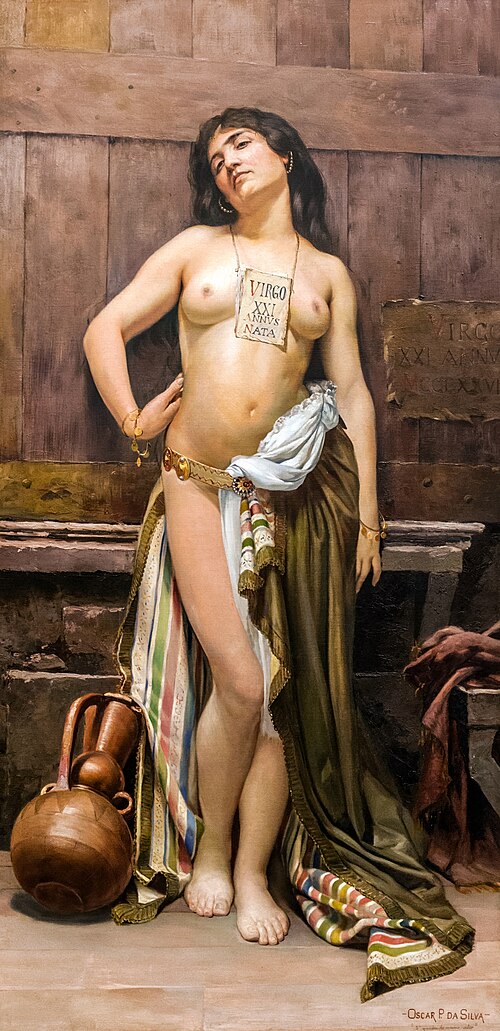
Nineteenth-century academic realism and dramatic historical narrative
Enrich your gallery collection with the striking emotional depth of Oscar Pereira da Silva’s 1882 historic masterpiece, Roman Slave (Escrava Romana). As one of the most prominent figures in Brazilian academic art, the painter masterfully captures a young captive woman leaning against a weathered wooden wall, bearing a poignant Latin inscription around her neck. The incredible use of light highlights the delicate drapery of her traditional garments, the metallic sheen of her ornaments, and the realistic textures of the terracotta vessels at her feet. It serves as an intellectually profound and sophisticated statement piece for classical libraries, private studies, or traditional living rooms.
Museum-grade giclee reproduction with stunning clarity
Each fine art poster is meticulously produced on ultra-durable heavy-weight paper using elite archival inks to ensure life-long color vibrancy. The sophisticated matte texture beautifully replicates the look of original modern art prints, preventing glares and reflections under standard room lighting. Designed to meet the highest standards of professional interior decorators, this colorful geometric design is available in multiple frame-ready dimensions to seamlessly enhance your curated home decor.
Contributor: Oscar Pereira da Silva (1867-1939)
Date: 1882
Reviews
Only logged in customers who have purchased this product may leave a review.
Delivery & return
Delivery & return
Next day delivery in store
Buy before 6pm to receive your order next day.FREE
Next day delivery
Orders before 6pm from Monday to Saturday (or before 1pm on Sunday) will be delivered Next working day (except Northern Ireland and Highlands). Orders placed after 6pm (after 1pm on Sunday) or for Northern Ireland and Highlands will be delivered in 2 working days.29 USD
Drop Point
In 2-3 working days. Pick up your parcel in one of the many diferent collection points available and during a wide range of hours.39 USD
Same day delivery in London:
Place your order before 13:00 to get it today!. If you order later on, you’ll receive it the next day and if you order on Sunday, you’ll receive it the next working day.59 USD
Shipping Info
Shipping Info
SHIPPING
Complimentary ground shipping within 1 to 7 business days In-store collection available within 1 to 7 business days Next-day and Express delivery options also available Purchases are delivered in an orange box tied with a Bolduc ribbon, with the exception of certain items See the delivery FAQs for details on shipping methods, costs and delivery timesComposition
Composition
Characteristics of wood :
- Hard, compact , fiberous and porous
- Good wood gives a rich, warm and beautiful surface.
Wood is used for the construction of:
- Floor, Furniture, Walls
- Incidental furnishing (lampshades, picture frames)
- Kitchen & restaurant ware







There are no reviews yet.