
Currently Empty: 0.00 €
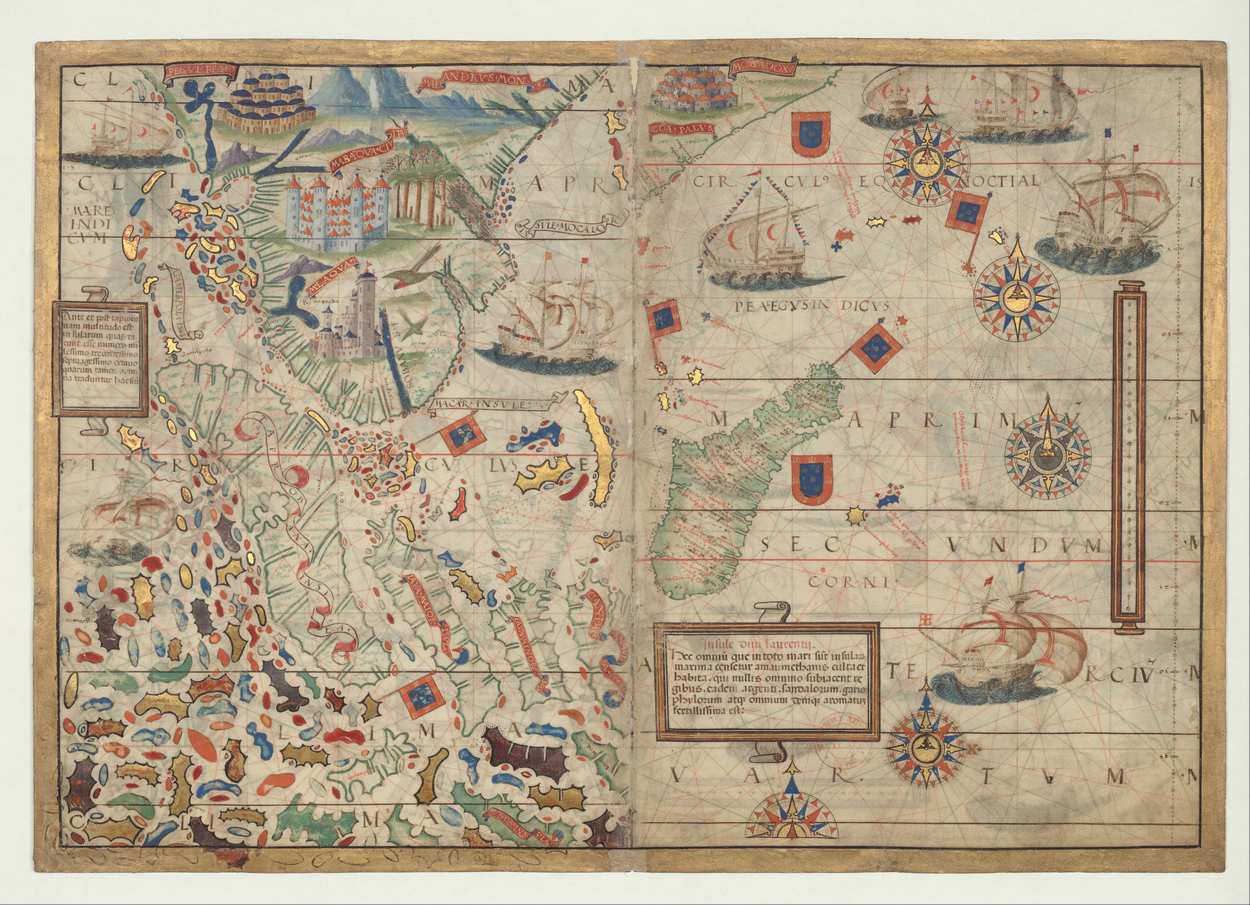
Adorn Your Space with the Opulence of the Miller Atlas
Immerse yourself in the pinnacle of Portuguese Renaissance cartography with this breathtaking reproduction from the legendary 1519 Miller Atlas. Crafted by master cartographers Lopo Homem and the Reinel family, with exquisite illustrations by António de Holanda, this double-page manuscript charts the Indian Ocean and the eastern coastline of Africa. Richly illuminated with golden details, intricate wind roses, and the iconic royal coats of arms, this chart famously displays Portuguese caravels navigating uncharted waters with majestic historical presence.
Museum-Grade Nautical Wall Art for Luxury Office and Home Decor
Bring the vibrant artistry and elite maritime heritage of the sixteenth century into your contemporary design scheme. The striking contrast between deep blue decorative borders, elaborate miniature fortresses, and beautifully detailed topographical islands makes this print an outstanding focal point. Tailored for sophisticated home libraries, nautical-themed living spaces, or corporate offices, this rare geographic masterpiece offers an unparalleled blend of academic depth and luxurious vintage aesthetic.
Note:
The official technical sheet detailing the authorship of the map shows exactly who the men were behind the creation of that page of the Miller Atlas in 1519.
António de Holanda (Illustrator)
He was one of the greatest illuminated manuscript painters of the time. He did not draw the geography of the map, but he was responsible for painting the artistic part: the detailed caravels at sea, the coats of arms, the tiny fortresses on land, and the decorative gilded borders.
Lopo Homem (Cartographer)
Lopo Homem was the Chief Cartographer of the Kingdom of Portugal. He was the official coordinator of the atlas project and responsible for plotting the navigation lines and geographical coordinates.
King Manuel I of Portugal
He was the king who commissioned and paid for this atlas. At that time, maps were invaluable state secrets. It is thought that King Manuel I commissioned this luxurious atlas as a prestigious diplomatic gift, possibly to King Francis I of France.
Jorge Reinel and Pedro Reinel (Cartographers)
Pedro Reinel (the father) and Jorge Reinel (the son) were two of the most brilliant Portuguese cartographers in history. They worked together with Lopo Homem to draw the outlines of the coasts of Africa and the Indian Ocean based on the secret accounts of navigators returning from the India Route.
In short, this map is not a simple old sheet, but a masterpiece that brought together the best cartographers and the best painter in Portugal, financed by the King of the Portuguese Discoveries himself
Contributor: António de Holanda, c. 1480-1556 Illustrator. Lopo Homem, flourished 1517-1565 Cartographer. Manuel I, King of Portugal, 1469-1521 Patron. Jorge Reinel, active 16th century Cartographer. Pedro Reinel, born c. 1464 Cartographer.
Date: 1519
Reviews
Only logged in customers who have purchased this product may leave a review.
Delivery & return
Delivery & return
Next day delivery in store
Buy before 6pm to receive your order next day.FREE
Next day delivery
Orders before 6pm from Monday to Saturday (or before 1pm on Sunday) will be delivered Next working day (except Northern Ireland and Highlands). Orders placed after 6pm (after 1pm on Sunday) or for Northern Ireland and Highlands will be delivered in 2 working days.29 USD
Drop Point
In 2-3 working days. Pick up your parcel in one of the many diferent collection points available and during a wide range of hours.39 USD
Same day delivery in London:
Place your order before 13:00 to get it today!. If you order later on, you’ll receive it the next day and if you order on Sunday, you’ll receive it the next working day.59 USD
Shipping Info
Shipping Info
SHIPPING
Complimentary ground shipping within 1 to 7 business days In-store collection available within 1 to 7 business days Next-day and Express delivery options also available Purchases are delivered in an orange box tied with a Bolduc ribbon, with the exception of certain items See the delivery FAQs for details on shipping methods, costs and delivery timesComposition
Composition
Characteristics of wood :
- Hard, compact , fiberous and porous
- Good wood gives a rich, warm and beautiful surface.
Wood is used for the construction of:
- Floor, Furniture, Walls
- Incidental furnishing (lampshades, picture frames)
- Kitchen & restaurant ware

There are no reviews yet.