
Currently Empty: 0,00 €
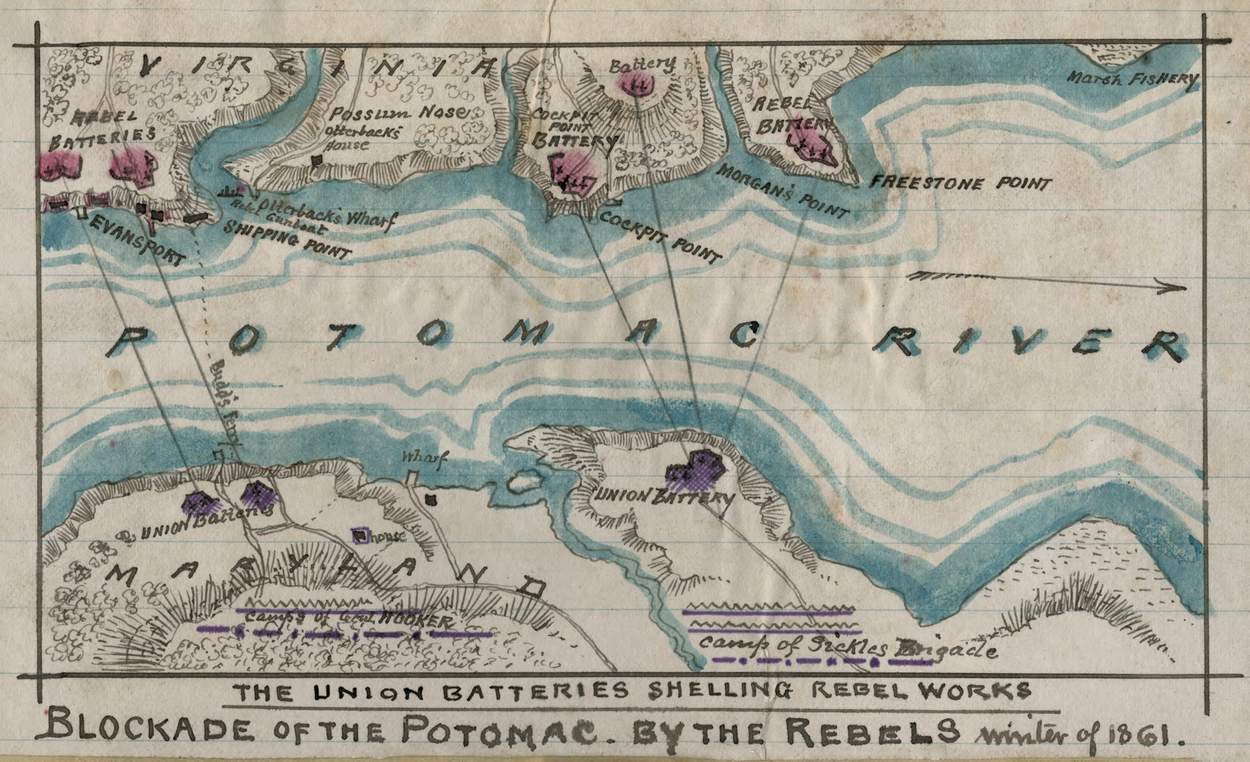
American Civil War Manuscript Sketch of the Potomac River Blockade
This rare hand-drawn military manuscript map documents the strategic naval blockade of the Potomac River during the winter of 1861. Executed with ink and watercolor washes on lined field paper, the tactical sketch illustrates the volatile combat theater separating Virginia and Maryland, highlighting the frontline positioning of artillery fortifications during the early stages of the American Civil War.
Confederate Artillery Positions and Union Army Encampments
The historic wartime illustration details the competitive placement of Confederate batteries at Cockpit Point and Evansport directly opposing the Union defensive works on the shore. Hand-annotated markers delineate the operational camps of General Hooker and the Sickles Brigade, capturing the raw, immediate nature of military reconnaissance drawing used to track active shoreline artillery duels.
Note: The calligraphy on this map appears, at first glance, completely anachronistic and modern, but the document is 100% authentic. The mystery behind this visual style is explained by the author and his working method.
This map was made by Robert Knox Sneden, a soldier, surveyor, and cartographer in the Union Army during the American Civil War. Unlike most 19th-century documents, which used highly ornate cursive calligraphy (such as Spencerian script), Sneden used a very clean and geometric sans-serif style. This technique was typical of draftsmen and civil engineers of the time, bearing a striking resemblance to modern architectural lettering or 20th-century comic book fonts.
Although the original sketches were made in the field in 1861-1862, Sneden spent the decades following the war rewriting, coloring with watercolors, and retouching his campaign diaries for publication. This means that some of the ink and final lettering was refined in the late 19th century, which accentuates the crisp and “recent” aspect of the text.
Sneden’s diaries and maps remained stored in a bank and forgotten for decades, only to be discovered in 1993 by the Virginia Historical Society, surprising historians precisely because of their incredible preservation and visual modernity.
Contributor: Robert Knox Sneden
Date: 1861
Reviews
Only logged in customers who have purchased this product may leave a review.
Delivery & return
Delivery & return
Next day delivery in store
Buy before 6pm to receive your order next day.FREE
Next day delivery
Orders before 6pm from Monday to Saturday (or before 1pm on Sunday) will be delivered Next working day (except Northern Ireland and Highlands). Orders placed after 6pm (after 1pm on Sunday) or for Northern Ireland and Highlands will be delivered in 2 working days.29 USD
Drop Point
In 2-3 working days. Pick up your parcel in one of the many diferent collection points available and during a wide range of hours.39 USD
Same day delivery in London:
Place your order before 13:00 to get it today!. If you order later on, you’ll receive it the next day and if you order on Sunday, you’ll receive it the next working day.59 USD
Shipping Info
Shipping Info
SHIPPING
Complimentary ground shipping within 1 to 7 business days In-store collection available within 1 to 7 business days Next-day and Express delivery options also available Purchases are delivered in an orange box tied with a Bolduc ribbon, with the exception of certain items See the delivery FAQs for details on shipping methods, costs and delivery timesComposition
Composition
Characteristics of wood :
- Hard, compact , fiberous and porous
- Good wood gives a rich, warm and beautiful surface.
Wood is used for the construction of:
- Floor, Furniture, Walls
- Incidental furnishing (lampshades, picture frames)
- Kitchen & restaurant ware

There are no reviews yet.